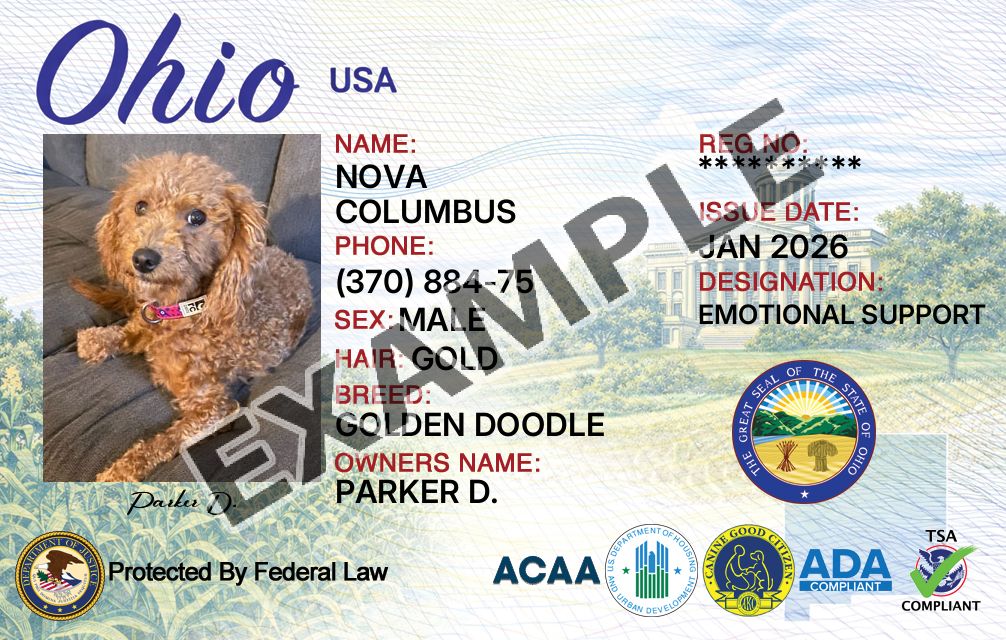
If you’re asking “where do I register my dog in Ohio for my service dog or emotional support dog”, the answer usually comes in two parts: (1) get a dog license in Ohio through your county auditor (or equivalent county office), and (2) understand that service dog legal status and emotional support animal (ESA) rules are not created by a paid “registration” website.
In Ohio, “registration” most commonly means a local dog license (sometimes called an animal control dog license Ohio residents must keep current). Whether your dog is a pet, a service dog, or an ESA, you typically still start with local licensing and rabies compliance, then apply the correct legal rules depending on where you need access (public places vs. housing).
Where to Register or License Your Dog in Ohio
Because dog licensing is often handled at the county level, the best place to start is your county auditor (or equivalent office). Below are several examples of official offices within Ohio that handle dog licensing, animal control coordination, and/or related enforcement. If your county isn’t listed, look for your county’s “Auditor” or “Fiscal Officer” and its dog licensing page.
Franklin County Auditor — Dog License Section (Columbus)
Notes: Franklin County’s dog licensing is administered through the county auditor’s licensing division.
Hamilton County Auditor’s Office (Cincinnati)
Notes: Dog licensing is a statutory duty commonly handled through the auditor’s office in Ohio counties.
Montgomery County Auditor’s Office (Dayton)
Notes: Montgomery County lists year-round dog license sales through the auditor and other official outlets.
Cuyahoga County Fiscal Officer (Cleveland) — Auditor Functions
Notes: In Cuyahoga County, the Fiscal Officer performs duties vested in county auditors, including licensing-related functions.
Overview of Dog Licensing in Ohio
What “registering your dog” usually means in Ohio
In Ohio, “registration” is most often the legal process of obtaining a dog license in Ohio (a dog tag/registration certificate issued by the county). Ohio’s dog laws place core licensing responsibility on county government, typically through the county auditor or an equivalent office, with animal control and dog wardens involved in enforcement.
Statewide baseline: age, timing, and where to file
Ohio law requires dog owners, keepers, or harborers to register dogs that are more than three months old. The application is filed with the county auditor in the county where the dog is kept/harbored, and Ohio’s standard renewal window runs from December 1 through January 31 (with the county commissioners able to extend the filing period by resolution). This is one reason licensing feels “local” even though the rules start in state law.
Rabies vaccination and licensing are connected
While rabies vaccination rules are enforced through public health channels and local authorities, Ohio dog law explicitly links licensing to rabies compliance: for dogs that are required to be vaccinated, proof of rabies vaccination must be shown to the county auditor before registration is issued. In practical terms, you should expect to provide a rabies certificate (or similar proof accepted by the county) when you apply for or renew an Ohio dog license.
Why this matters for “animal control dog license Ohio” questions
People often search for an animal control dog license Ohio because animal control interacts with dogs in the community (lost dogs, bite investigations, running at large, nuisance issues). But the license itself is typically issued by the county auditor (or equivalent), not by a private registry or “certification” site.
How Dog Licensing Works Locally in Ohio
Step 1: Find the correct licensing office for your address
Start with your county. In most counties, you’ll license through the County Auditor. In some counties, the role may be carried out by a Fiscal Officer who performs auditor duties. If you live inside a city, animal control may be run by a city department, but the dog license in Ohio is still generally a county-issued registration.
Step 2: Choose a license type (when available)
Ohio law allows for different registration lengths (commonly 1-year, 3-year, or permanent) depending on what your county offers and how it administers licensing. Many counties also have separate rules and additional requirements for dogs designated as nuisance, dangerous, or vicious, which can include added documentation.
Step 3: Gather documentation and pay the fee (or request an exemption, where applicable)
Counties typically require owner contact information and rabies vaccination proof. Fees and discounts vary by county (for example, spayed/neutered vs. not spayed/neutered). Some dogs may qualify for a different registration category under Ohio law (discussed below), but you should still complete the licensing process with your official county office.
Step 4: Keep your tag/current registration information accessible
A current license tag helps with identification and reunification if your dog is found. It can also reduce complications during an animal control encounter (for example, a loose dog pickup or a bite investigation) because ownership and contact details are easier to verify.
Service Dog Laws in Ohio
A service dog is not created by “registration”
Under the Americans with Disabilities Act (ADA), a service animal is a dog trained to perform a task directly related to a person’s disability. Importantly, service animals are not required to be certified, to attend a professional training program, or to wear a vest/ID. That means there is no official federal “service dog registry” that turns a pet into a service dog.
What businesses can ask (public access basics)
In many public settings, staff are generally limited to asking two questions when it’s not obvious: whether the dog is required because of a disability and what work or task the dog has been trained to perform. They typically cannot demand proof of certification as a condition of entry.
How licensing intersects with service dogs in Ohio
A dog license in Ohio is a local registration requirement separate from ADA public-access status. In other words:
- Dog license = local/county registration and tag (ownership and compliance)
- Service dog status = federal disability law standard (training + disability-related tasks)
Ohio law also includes provisions for a specific category of “assistance dogs” with a permanent registration option in certain circumstances, but this state-law registration category is separate from (and does not replace) the ADA definition used for public access. If you believe your dog may qualify under an Ohio-specific assistance-dog registration program, confirm the exact documentation your county auditor requires.
Emotional Support Animal Rules in Ohio
An ESA is not a service dog under the ADA
Emotional support animals provide comfort and support, but under the ADA, emotional support or comfort alone is not a trained task and therefore does not qualify a dog as a service animal for public access purposes. That means an ESA generally does not have the right to enter non-pet public places the way a task-trained service dog can.
Where ESAs matter most: housing accommodations
ESAs are most commonly addressed through housing accommodation rules. While a dog license is about county registration, an ESA accommodation is typically supported by documentation from a healthcare provider (for example, a letter confirming the disability-related need for an assistance animal accommodation, depending on the situation).
Dog licensing still applies locally
Even if your dog is an ESA, you generally still need to license the dog locally (county auditor) and follow rabies vaccination requirements. So when people ask where to register a dog in Ohio for an ESA, the practical answer is: register for the county dog license, and keep separate documentation for any housing accommodation request.
Frequently Asked Questions
Where do I register my dog in Ohio for my service dog or emotional support dog?
For licensing, you typically register through your county auditor (or equivalent office such as a county fiscal officer performing auditor functions). That’s the main answer to where to register a dog in Ohio for official licensing. Service dog and ESA status are separate legal concepts and are not established by paying a third-party registration site.
Is there a statewide Ohio “service dog registry” I must use?
No federal ADA rule requires service dogs to be registered, certified, or professionally trained. If your dog is task-trained to help with a disability, that training and function are what matter for ADA public access—not a paid ID card or online “registration.”
Do I need rabies proof to get a dog license in Ohio?
Often, yes. Ohio dog law links registration issuance to rabies vaccination proof for dogs that are required to be vaccinated. Your county auditor’s office can tell you exactly what proof format they accept.
Is a dog license the same thing as “animal control registration”?
The terms get mixed together online. The animal control dog license Ohio residents talk about is typically the county-issued dog license/tag. Animal control or the dog warden may enforce compliance, but the licensing paperwork is usually handled by the county auditor’s office.
If my dog is an ESA, can I take them into stores and restaurants?
Generally, no. ESAs are not service animals under the ADA for public access. A task-trained service dog may have access rights in many public places; an ESA typically does not (outside of pet-friendly policies).
What if I moved to a new county in Ohio?
Licensing is county-based, so you should contact your new county auditor (or equivalent office) to confirm when and how to obtain or transfer licensing and update your address records.